How PU Injection Grouting Solves Inter-Floor Ceiling Leaks
If you live in a multi-story HDB or condominium in Singapore, a brown stain or active water dripping from your false ceiling is a common nightmare. This happens when the waterproofing in the unit above fails, allowing water to travel through microscopic cracks in the concrete floor slab and into your home.
Traditional repairs often involve complex negotiations to hack up the upstairs neighbour’s floor. But at Pro Waterproofing Singapore PTE. LTD, we offer a smarter, faster, and highly effective alternative: High-Pressure PU Injection Grouting.
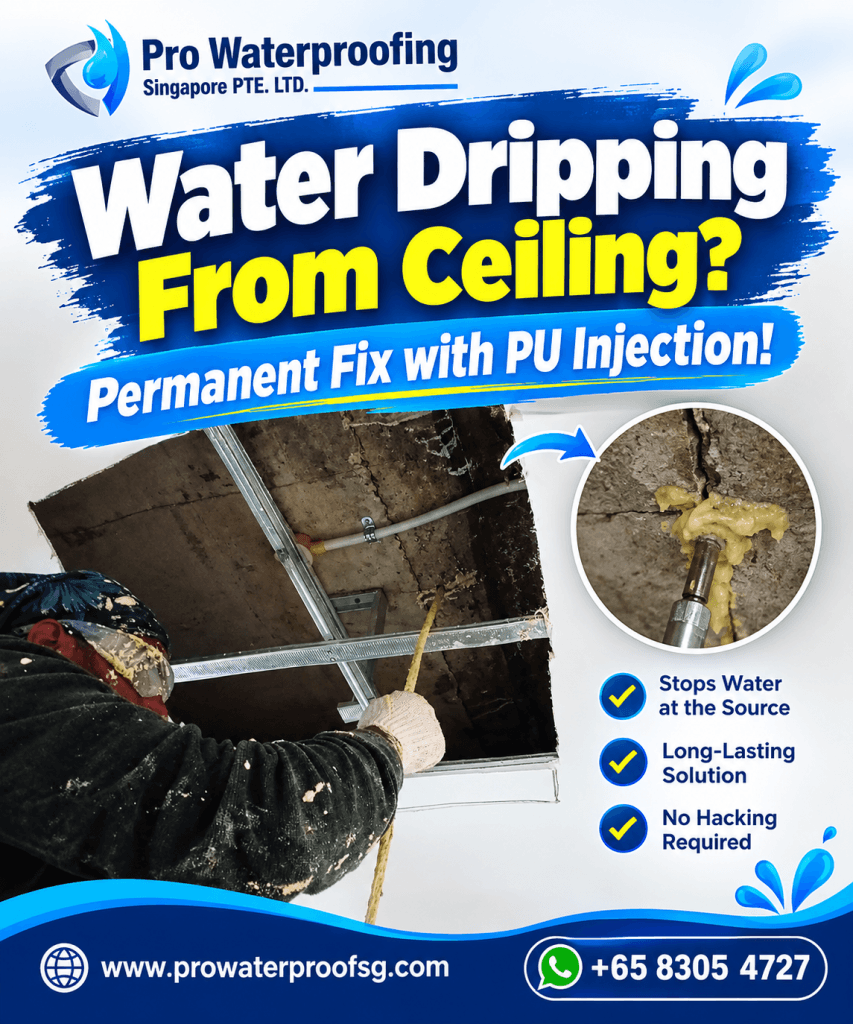
Seeing the Solution in Action
As demonstrated by our waterproofing specialist in our latest project, PU injection tackles the problem from the “negative side” (your ceiling). Our technicians use high-pressure pumps to inject expanding polyurethane resin directly into the cracks in the concrete slab. The resin reacts with the moisture present, expands to fill every void, and forms a permanent, watertight seal.
What is PU Injection Grouting?
PU (Polyurethane) Injection Grouting is a specialised waterproofing technique that injects expanding polyurethane resin into cracks, joints, or voids within concrete structures under high pressure. The resin reacts with any moisture present, expanding up to 20 times its original volume to fill the crack completely and form a dense, watertight seal.
This method is widely recognised as Singapore’s most effective non-hacking waterproofing solution for concrete structures. It is approved by the Building and Construction Authority (BCA) and is the preferred choice for resolving ceiling leaks in HDB flats and condominiums.
The Science: How Polyurethane Resin Works
Understanding the science behind PU injection explains why it is such a powerful and permanent solution for ceiling leaks.
1. Chemical Reaction with Water
Polyurethane injection resin is a two-component system that remains stable until it comes into contact with water. When injected into a wet crack, the resin undergoes a rapid chemical reaction (polymerisation). The water acts as a catalyst, triggering the resin to cure and harden. This means the resin only sets where it is needed—exactly where the water is.
2. Expansion and Pressure
As the resin reacts, it expands dramatically—up to 20 times its original liquid volume. This expansion is driven by the high-pressure injection pump (typically 100–200 bar), which forces the resin deep into the smallest fissures and voids. The expanding foam exerts pressure against the crack walls, ensuring a complete and tight fill that water cannot penetrate.
3. Flexibility and Durability
Once cured, the polyurethane resin remains slightly flexible, accommodating the natural thermal expansion and contraction of the concrete structure. Unlike rigid epoxy, PU resin will not crack under movement. It is also resistant to most chemicals, UV exposure, and ageing, ensuring a long-lasting seal.
Why “Negative Side” Injection is a Game Changer
Traditional waterproofing is often applied to the “positive side”—the side where water originates. This means hacking the floor of the unit above to replace the waterproofing membrane. This approach is disruptive, costly, and requires cooperation from your neighbour.
PU injection works from the “negative side”—your ceiling. Water is still trying to enter, but the expanding resin seals the crack from the inside, blocking its path. This means:
- No need to hack the upstairs floor.
- No disruption to your neighbour.
- Faster, cleaner, and more cost-effective repairs.
- Immediate stopping of active leaks.
Our Proven PU Injection Protocol
We follow a systematic, proven approach to ensure a permanent, leak-free ceiling:
- Detailed Inspection & Moisture Mapping: We use thermal imaging cameras and moisture meters to pinpoint the exact source of the leak—often invisible to the naked eye.
- Strategic Drill & Injection Port Installation: We drill small holes (typically 8–12 mm) along the crack path at precise intervals and install injection packers (ports).
- High-Pressure PU Resin Injection: Using specialised injection pumps, we force the polyurethane resin deep into the crack under high pressure, ensuring it reaches the furthest voids.
- Chemical Reaction & Expansion: The resin reacts with any moisture present, expanding to fill every gap and forming a flexible, impermeable seal that moves with the building.
- Clean Removal & Finishing: Once the resin cures, we remove the injection ports, grind the surface flush, and apply a finishing coat to restore the ceiling’s appearance.
- 24-Hour Observation: We monitor the repaired area to ensure no further water ingress before final handover.
Benefits of PU Injection for Ceiling Leaks
The expanding resin seals cracks within minutes, stopping water flow on the spot.
Works from the negative side (your ceiling)—no need to disturb the upstairs unit’s floor.
Significantly cheaper than full hacking and re-waterproofing.
Most jobs completed within a single day with minimal mess.
Recognised by Singapore’s Building and Construction Authority for concrete crack repair.
When applied correctly, PU injection provides a permanent, durable waterproof seal.
PU Injection vs. Traditional Hacking for Ceiling Leaks
| Factor | PU Injection Grouting | Traditional Hacking & Re-tiling |
|---|---|---|
| Disruption | Minimal—small drill holes only | Extensive—full demolition required |
| Time Required | 3–4 hours for standard jobs | 3–5 days or more |
| Cost Range | $300 – $1,200 (1–2 ports) | $2,000 – $5,000+ |
| Neighbour Cooperation | Not required—work done from your unit | Required—upstairs floor must be hacked |
| Effectiveness | Permanent seal—resin expands to fill all voids | Dependent on new membrane installation |
| Warranty | Up to 10 years | Varies |
Common Causes of Ceiling Leaks in Singapore
Understanding why ceiling leaks occur helps prevent future problems. The most common causes include:
- Degraded waterproofing membrane: The membrane in the bathroom or kitchen of the unit above has failed.
- Cracked floor slab: Thermal movement or structural settling creates micro-cracks in the concrete.
- Faulty pipe penetrations: Leaking pipes or loose fittings within the floor slab.
- Poor drainage falls: Water ponds on the floor above, increasing hydrostatic pressure.
- Ageing building materials: Older HDB blocks may have compromised waterproofing layers.
Stop Your Ceiling Leak Today
Don’t wait for a small drip to turn into a collapsed ceiling. A minor leak can quickly escalate into structural damage, mold infestation, and costly repairs. Trust the experts who understand the science of waterproofing.
With our 10-year workmanship warranty and BCA-approved methods, you can be confident that your ceiling leak is fixed permanently—without the hassle of hacking or neighbour disputes.
📞 Schedule Your Free Ceiling Leak Inspection
Frequently Asked Questions About PU Injection Grouting
What is PU injection grouting for ceiling leaks?
PU (Polyurethane) injection grouting is a specialised waterproofing technique where expanding polyurethane resin is injected into concrete cracks under high pressure. The resin reacts with moisture, expands to fill the crack, and forms a permanent, watertight seal—all without hacking or demolition.
How does PU injection stop ceiling leaks permanently?
PU injection works by injecting expanding polyurethane resin into the crack. The resin reacts with water, expands up to 20 times its volume, and fills every void. Once cured, it forms a flexible, durable seal that prevents water from entering—even under hydrostatic pressure. This makes it a permanent solution for most ceiling leaks.
How much does PU injection ceiling leak repair cost in Singapore?
For standard ceiling leaks, PU injection typically costs between $300 and $1,200 depending on the severity and number of injection ports required. More extensive cases with multiple cracks may cost up to $2,000. We provide a detailed, no-obligation quote after a site inspection.
Does PU injection require hacking or demolition?
No. PU injection is a non-hacking solution. The process only requires small drill holes (8–12 mm) to install injection ports. There is no demolition, no dust, and no need to disturb the upstairs unit’s floor. This makes it the preferred choice for resolving ceiling leaks with minimal disruption.
How long does PU injection ceiling repair take?
For most standard ceiling leaks, the entire PU injection process takes 3 to 4 hours. This includes inspection, drilling, injection, and clean-up. The area can typically be used again within 24 hours after the resin has fully cured.
Is PU injection approved by HDB and BCA?
Yes. PU injection grouting is an accepted waterproofing method recognised by the Building and Construction Authority (BCA) for concrete crack repair. For HDB work, we are registered in the HDB Directory of Renovation Contractors (DRC) and comply with all HDB renovation regulations.
Who is responsible for fixing an HDB ceiling leak?
For HDB inter-floor leaks, the responsibility is shared jointly between the upper and lower-floor flat owners. Both parties should discuss the issue, arrange for a contractor together, and split the repair costs. HDB provides assistance under the Goodwill Repair Assistance (GRA) scheme in certain cases.