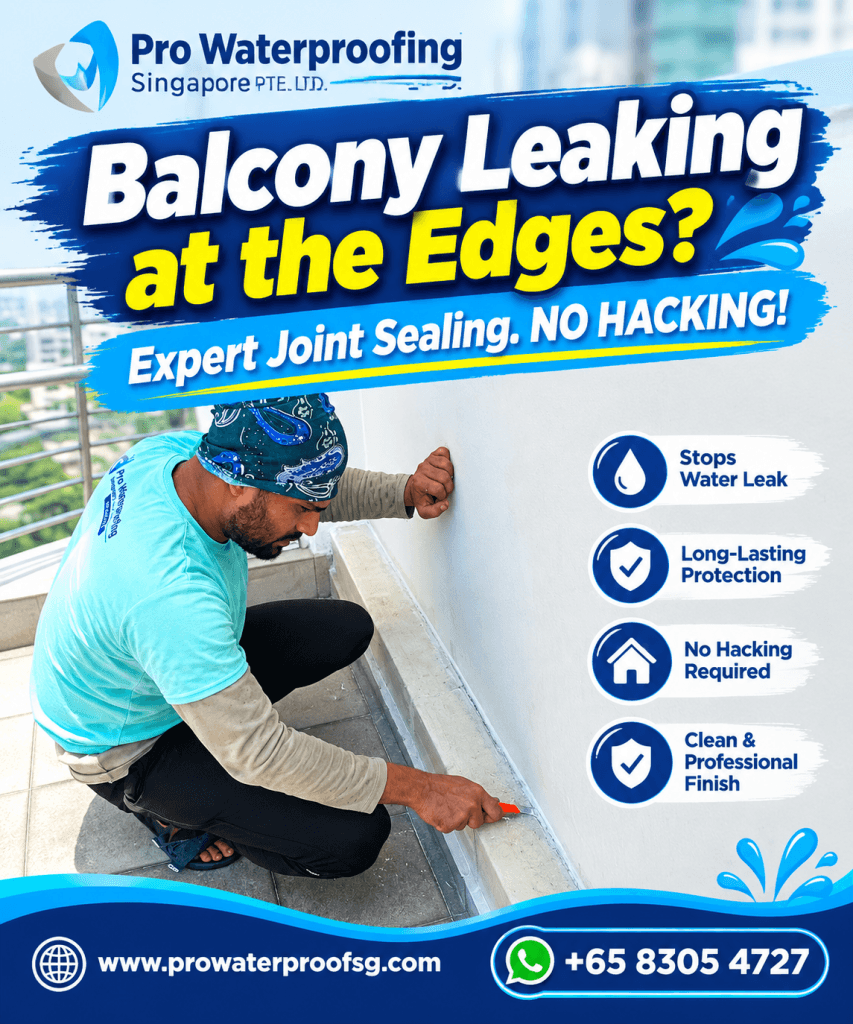
The Secret to a Leak-Free Balcony: Expert Edge Sealing & Preparation
Why Wall-to-Floor Joints are the Biggest Threat to Your Balcony
When homeowners in Singapore face a leaking balcony, they often assume the entire floor membrane has failed. However, in almost 90% of cases, the seepage originates at the weakest points of the structure: the edges, skirting, and wall-to-floor joints. The constant cycle of intense sunlight and heavy monsoon rains causes these specific areas to expand and contract, eventually cracking the grout and sealant.
At Pro Waterproofing Singapore PTE. LTD, we know that stopping a leak permanently requires targeted edge detailing before any waterproofing membrane is applied.
Why Wall-to-Floor Joints Are the Biggest Threat
Balconies are constantly exposed to Singapore’s harsh tropical weather. The wall-to-floor joint—where the horizontal floor slab meets the vertical wall or parapet—is particularly vulnerable for several reasons:
- Thermal Expansion & Contraction: Concrete expands in the heat and contracts in the cool of the night. This constant movement stresses the joint, causing sealants and grout to crack.
- Water Accumulation: During heavy rain, water naturally flows toward the edges of the balcony. If the joint is not properly sealed, water pools and penetrates the structure.
- Poor Initial Workmanship: Many balconies are constructed with inadequate edge detailing, leaving gaps that only become apparent after years of exposure.
- Ageing Sealants: Over time, even high-quality sealants degrade and lose their elasticity, creating pathways for water ingress.
The Importance of Meticulous Surface Preparation
As you can see from our trained technicians on-site, a lasting repair is all about the preparation. Applying a waterproofing coating over old, loose debris is a temporary bandage, not a solution.
Proper surface preparation ensures:
- Optimal Adhesion: A clean, sound surface allows the sealant and membrane to bond chemically and mechanically with the substrate.
- Elimination of Weak Points: Cracks, voids, and hollow tiles are repaired before the membrane is applied, preventing future water paths.
- Moisture Control: Trapped moisture within the concrete can cause the membrane to blister and delaminate. Proper drying and priming prevent this.
- Long-Term Durability: A well-prepared surface extends the lifespan of the waterproofing system, saving you money on premature repairs.
Our Professional No-Hacking Protocol
We follow a systematic, proven approach that addresses both the edges and the tile surface without any demolition. Our professional No-Hacking protocol includes:
- Thorough Inspection & Moisture Mapping: We use thermal imaging cameras and moisture meters to identify all areas of water ingress and hidden dampness.
- Deep Cleaning & Contaminant Removal: We remove dirt, grease, mold, and old sealant using industrial-grade cleaners and high-pressure washing. This ensures a perfectly clean surface for bonding.
- Crack & Void Repair: All visible cracks, hollow tiles, and voids are repaired using epoxy or cementitious patching compounds.
- Edge Preparation & Sealing: We meticulously clean and prepare all edges, joints, and gaps before applying a high-grade flexible sealant reinforced with fabric. This step is critical—it accommodates thermal movement and prevents water from entering the most vulnerable areas.
- Primer Application: A specialised primer is applied to enhance bonding between the prepared surface and the waterproofing membrane.
- Clear Waterproofing Membrane Application: We apply multiple coats of our premium-grade, UV-stable clear membrane, ensuring full coverage and the required thickness.
- Curing & Inspection: The membrane is left to cure fully, then inspected for pinholes or thin spots.
- 24-Hour Ponding Test (Optional): For added assurance, we can conduct a water ponding test to verify zero leakage before final handover.
How Edge Sealing Works
Edge sealing is not simply applying a bead of silicone. It is a multi-step process that requires careful preparation and the right materials:
- Joint Cleaning: The joint is cleaned of all debris, old sealant, and contaminants using specialised tools and solvents.
- Backer Rod Installation: A closed-cell backer rod is inserted into the joint to control the depth of the sealant and allow for proper movement.
- Primer Application: A primer is applied to the joint surfaces to enhance adhesion.
- Sealant Application: A high-grade, flexible polyurethane or hybrid sealant is applied and tooled to a smooth finish.
- Reinforcement: At critical corners and junctions, reinforcing fabric is embedded into the sealant to prevent future cracking.
Traditional Hacking vs. Our No-Hacking Preparation-First Approach
| Factor | Traditional Hacking | Our No-Hacking Method |
|---|---|---|
| Disruption | Extreme noise and dust | Minimal—no demolition required |
| Timeline | 3–5 days or more | As fast as 4–6 hours |
| Cost | Higher due to labour and materials | More cost-effective |
| Aesthetics | Tiles are replaced—may not match originals | Original tiles remain visible |
| Risk of Damage | May damage concealed pipes or waterproofing | No risk of collateral damage |
| Warranty | Varies | Up to 10 years |
Benefits of Professional Edge Sealing & Preparation
A properly prepared and sealed edge ensures the membrane bonds for life, preventing future leaks.
No hacking—your beautiful balcony floor remains intact.
Most jobs completed within a day, with zero toxic dust or construction noise.
Significantly cheaper than traditional hacking and re-tiling.
Formulated to withstand Singapore’s intense sun and heavy monsoon rain.
Backed by our 10-year workmanship warranty for peace of mind.
Trust the In-House Experts
We do not rely on ad-hoc sub-contractors. Our uniformed, in-house team is trained to execute every step with precision, ensuring your home is protected against the harshest weather. From the initial inspection to the final ponding test, every aspect of our work is carried out by our own trained technicians who take pride in their craftsmanship.
Don’t let a leaking balcony damage your home’s interior or lead to costly disputes with your neighbours below. Choose the modern, cost-effective, and proven waterproofing solution that saves you time, money, and stress.
📞 Request a Free Balcony Inspection & Quote
Frequently Asked Questions About Balcony Edge Sealing & Preparation
Why is edge sealing important for balcony waterproofing?
Edge sealing is critical because up to 90% of balcony water seepage originates from the joints where the floor meets the wall, and the gaps under sliding glass doors. These areas are subjected to high thermal expansion and are the primary entry points for water. Proper edge sealing creates a watertight, movement-accommodating barrier that prevents water from entering the structure.
What is surface preparation and why does it matter?
Surface preparation is the process of cleaning, repairing, and priming the substrate before applying a waterproofing membrane. It matters because a membrane is only as good as the surface it bonds to. Without proper preparation, the membrane can peel, blister, or fail prematurely, leading to recurring leaks and costly repairs.
How much does no-hacking balcony waterproofing cost in Singapore?
Costs typically range from $800 to $2,000 for a standard balcony, depending on size, condition, and the specific system used. This is significantly lower than traditional hacking and re-tiling, which can cost $3,000 or more. We provide a detailed, no-obligation quote after a site inspection.
How long does the no-hacking balcony waterproofing process take?
Most balcony waterproofing jobs are completed within 4 to 6 hours. The clear membrane is foot-trafficable once cured, typically within 24 hours, so you can resume normal use of your balcony almost immediately.
Does clear waterproofing change the appearance of my tiles?
No. Our clear membrane is completely transparent and does not alter the colour or texture of your tiles. It forms an invisible protective layer that preserves the original aesthetic of your balcony while providing lasting waterproofing protection.
Is no-hacking waterproofing approved by HDB and BCA?
Yes. No-hacking waterproofing methods are widely accepted for HDB renovations, provided they are carried out by a licensed contractor and pass the mandatory 24-hour ponding test. Our systems are fully compliant with HDB and BCA requirements for wet area waterproofing.
How long does the waterproofing last?
When applied correctly by experienced professionals, our clear waterproofing system can last 10 to 15 years or more. It is UV-resistant, flexible, and designed to withstand Singapore’s harsh weather conditions. We back our work with a 10-year workmanship warranty.